


Crafting a Beneficial Family Rhythm: A Handy Guide for Occupied Caregivers
In our fast-moving era, where professional duties overlap with family needs, numerous time-pressed guardians find themselves in a daily sprint against the clock. Handling the home, looking after youngsters, meeting work obligations, and nurturing family ties—these are all activities that consume vitality and deplete hours. Yet amidst this structured turmoil, a pressing need arises for a foundational element of stability: The Beneficial Family Rhythm.
Rhythm is more than just a rigid timetable or a checklist of chores. When deliberately put together, it evolves into a potent structure that offers reassurance, establishes sound behaviors, reinforces family bonds, and—crucially for weary parents—generates segments of foretold tranquility within an otherwise frenetic week. For the preoccupied caregiver, a positive rhythm is not an extravagance; it’s an essential aid, a deliberate approach to regaining moments, lessening the burden of constant choices, and cultivating a peaceful domestic atmosphere.
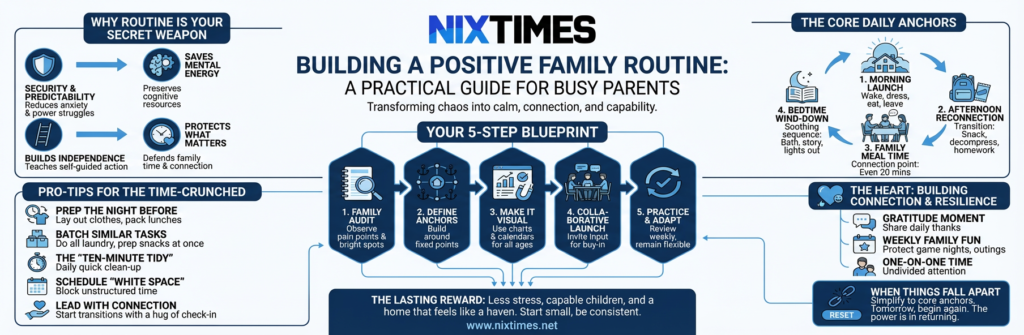
Why Rhythm is Your Hidden Asset (Not a Constraint)
Before exploring the “how,” let’s revisit the “why.” Many resist rhythms, worried about inflexibility or the loss of spontaneity. However, a positive family rhythm is the antithesis of restriction; it’s the framework that grants freedom.
- Predictability Fosters Security: For youngsters, knowing what follows alleviates worry and arguments. “We always share a story after toothbrushing” resolves the evening debate before it even starts.
- It Conserves Mental Energy: Every choice you avoid (“What’s on the menu for mid-week?” “When will schoolwork be done?”) frees up valuable mental capacity for significant matters.
- It Cultivates Accountability & Self-Reliance: Clear rhythms show children step-by-step how to manage their own time and duties, transitioning from “Parent, what’s next?” to independent action.
- It Safeguards What Counts: Without a rhythm, family outings, mealtimes, and closeness are the first things overtaken by busyness. A rhythm defends these important elements.
Designing Your Plan: A Sequential Approach
Establishing a sustaining rhythm is a joint venture, not a directive from above. Follow these stages to create one that suits your distinct household.
Stage 1: The Household Snapshot (Pour a Drink and Observe)
Don’t start from zero. Take a few days to simply watch the natural unfolding of your week. Note the friction points (the cluttered mornings, the stressful study periods, the constant evening haggling) and the smooth periods (the quiet moments, when things progress well). Pinpoint the fixed requirements (school start times, work hours, bedtimes) and the adaptable intervals in between.
Stage 2: The Primary Cornerstones
Base your rhythm around 3-4 daily anchors. These are the fixed markers that everything else orbits around.
- Morning Start: A calm, predictable commencement. (Example: Rise, dress, morning meal, depart for school).
- Afternoon/Evening Reconnect: The shift from work/school back to base. (Example: Snack, quiet time to unwind, then academic tasks).
- Shared Mealtime: Even if brief, guard this moment of bonding.
- Evening Unwind: A regular, soothing sequence to signal the day’s close. (Example: Bath, sleepwear, tale, lights off).
Stage 3: Make It Visible and Handy
A rhythm confined to your thoughts offers no assistance to the household.
- For Young Children: Utilize a visual chart with magnetic pieces or hook-and-loop fasteners.
- For Older Children: Develop a simple, bright list for morning and evening duties.
- For Everyone: A shared family board (digital like a shared diary or physical planner).
Stage 4: The Joint Launch
Hold a brief family huddle. Introduce the draft rhythm not as absolute law, but as “our new approach to making mornings lighter and evenings more enjoyable.” Solicit input. Feeling ownership boosts adoption.
Stage 5: Experiment, Reflect, and Adjust
The initial week is for trying it out, not for grading performance. Expect wobbles. On Sunday evening, do a brief check-in. Adaptability is vital.
Expert Hints for the Time-Poor Guardian
- Prepare the Prior Evening: This is the cardinal rule. Arrange clothing, pack midday meals, and organize items for the morning meal.
- Group Related Tasks: Handle all laundry tasks on one day, assemble weekday snacks in one session.
- The “Quick Tidy”: Set a timer for ten minutes each evening where everyone addresses clutter.
- Book “Empty Space”: Deliberately secure unscheduled, unstructured time on the planner.
- Lead with Warmth, Not Criticism: Begin routine shifts with an embrace, a smile, or an inquiry.
The Core of the Rhythm: Fostering Connection
The final aim of a rhythm isn’t just smooth operation—it’s connection. Integrate these components into your daily structure:
- Appreciation Point: Share one thing you feel grateful for during the evening meal.
- Weekly Shared Enjoyment: Game gatherings, movie nights, Sunday walks—protect this time firmly.
- Individual Attention: Even ten minutes of focused listening with each child yields significant benefits.
When the Plan Goes Awry (And It Will)
You will have disorderly days. The strength lies not in flawless execution, but in having a default setting to return to. On such days, simplify. Focus only on the main cornerstones and start anew the next day.
The Enduring Benefit
Establishing a positive family rhythm demands an initial expenditure of time and effort. But the reward is immeasurable: reduced strain, increased joy, competent youngsters, and a dwelling that feels like a sanctuary. Begin modestly, remain steady, and witness the structure you create becoming the base for a more serene, happier family existence.
Additional Resources:
- For printable routine charts and templates, visit Understood.org’s executive function resources
- Explore more about child development stages at Zero to Three